
Iron County MI-VINE Release Coverage
MI-VINE is Michigan’s free Victim Information and Notification Everyday service. It is available through Michigan VINELink, the VINEmobile app, or the automated line at 800-770-7657. TTY service is 866-847-1298. The service runs around the clock and can provide custody information along with registration for selected status changes.
For participating county-jail records, the Michigan material identifies release, transfer, and escape notifications. For MDOC, the VINELink layer provides general release notice. The reporting agency matters. A result tied to the Iron County Correctional Facility concerns that custody feed. A state-prison result concerns MDOC. Neither result automatically clears another county, federal, immigration, or court hold.
The official MI-VINE overview describes the service and its notification role.
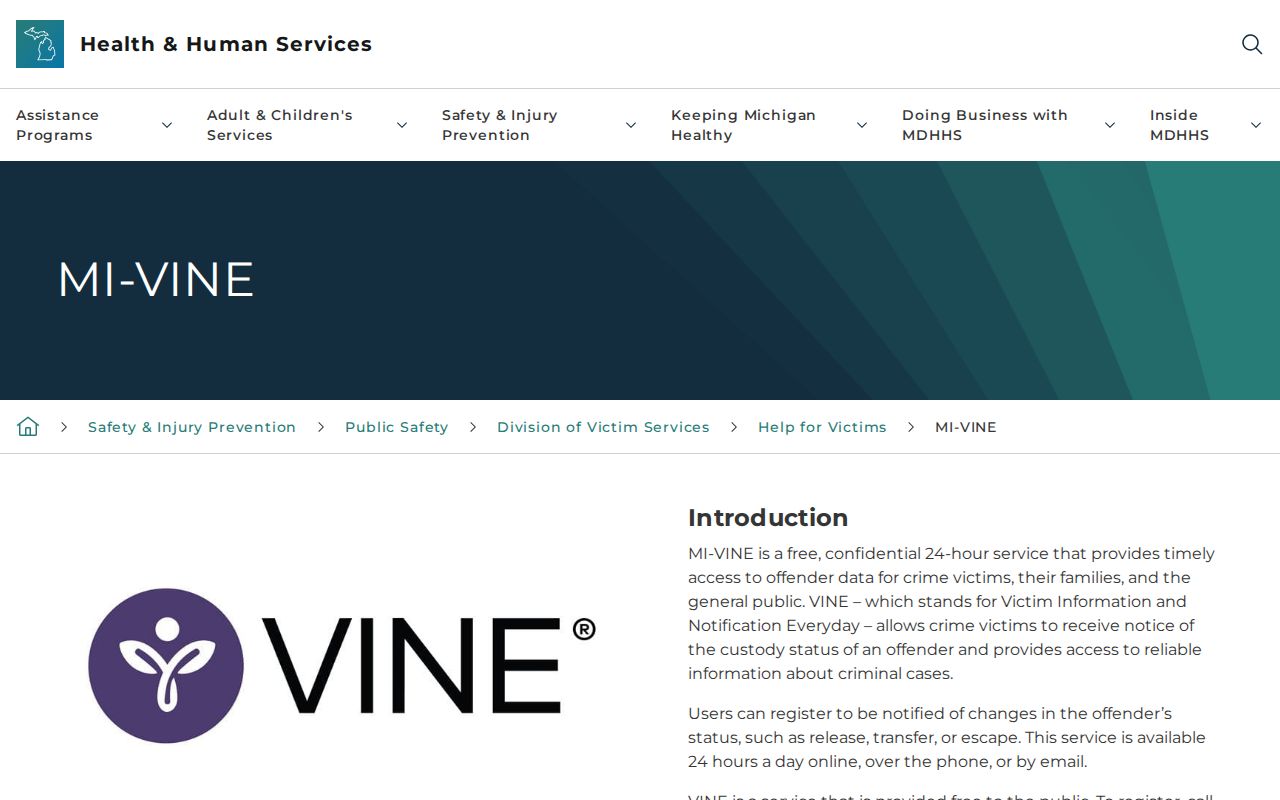
The state page confirms that MI-VINE is an alert and custody-information channel, not an Iron County certified release archive.
Search an Iron County Inmate
Begin with the exact person, not a broad recent-release query. Iron County does not publish an official online roster or released-person feed located in the research sweep, so MI-VINE can provide a useful reported event when a participating record is available. A name alone is not enough. Compare date of birth, displayed details, offender or booking ID, facility, and jurisdiction before treating a match as the right person.
The VINELink search entry opens with a location choice. Select Michigan before entering identifying facts. A Utah result for a same-named county is not an Iron County, Michigan record.
- Open VINELink and choose Michigan as the reporting state.
- Select “Find an Offender.” Enter the full name or offender or booking identifier supported by the search.
- Use date of birth and the displayed identifiers to separate people with similar names. Check spelling and aliases if no record appears.
- Open the matched record. Record the reporting jurisdiction or facility, custody status, and event shown.
- If the status says “released” or an equivalent term, read it as departure from that reporting custody. Check whether the event was a transfer.
- When an exact time, reason, authority, or destination matters, confirm it with the jail, MDOC, court, or receiving agency.
For a wider county, court, state, and federal verification path, use the Iron County released inmates search. VINELink is one layer within that process.
Note: A missing result can reflect spelling, feed coverage, timing, or an older event, so it does not prove there was no custody.
Iron County VINELink Release Fields
MI-VINE displays the facts supplied by the participating agency. The exact set can vary, but the research supports several core field types. Always tie the event to the source jurisdiction. A county “released” event can mean a community departure or a handoff. A state general-release notice does not establish final discharge from all MDOC authority.
| Field or control | What it tells an Iron County searcher |
|---|---|
| Jurisdiction or location | The agency or facility whose custody data produced the record |
| Name and offender ID | Identifiers used to compare the result with the intended person |
| Custody status | The status reported by that source, such as in custody or released |
| Facility | The reported holding location when one is supplied |
| Event information | A release, transfer, escape, or other supported custody change |
| Notification methods | Phone, email, or text choices offered for the matched record |
For an MDOC prisoner, OTIS adds sentence-specific fields such as Earliest Release Date, Maximum Discharge, Date Paroled, and Discharge Date or Reason. OTIS is distinct from MI-VINE. For an Iron County jail-only case, OTIS will not supply the local release record. The Sheriff’s record remains the durable source.
Register Iron County Release Alerts
Registration starts from a matched record. Do not register from an uncertain same-name result. Check the jurisdiction and identifiers first. The method selected controls how the alert arrives and whether a PIN is needed to acknowledge it.
- Open the matched Michigan record and select “Notify Me of Status Changes.”
- Choose telephone, email, text, or the available combination, then enter the destination information.
- For telephone notice, create a four-digit PIN and complete the confirmation step. Email and text registration do not use that PIN.
- When the automated call arrives, listen to the message and enter the PIN followed by the pound sign. Acknowledgment stops repeat calls.
- If a call is not answered and acknowledged, the system may repeat it for up to 72 hours.
- For a forgotten PIN or registration help, call 800-770-7657 and use operator assistance.
The alert is a prompt to verify, not a final document. For an Iron County event, ask whether custody ended through community release or transfer. For an MDOC event, check OTIS for parole or discharge status. Save the date of each check because source systems can update at different times.
If the notice arrives before pickup or a planned court visit, call the Iron County jail at 906-875-0651. Ask whether the order has arrived, whether processing is complete, and whether the event was a release to the community or a transfer. The Sheriff’s operation is staffed around the clock, but that does not establish a fixed release schedule. A VINE alert should not be read as a promise that a person is ready at a public entrance.
The VINELink Michigan selection screen is the entry point for the public search and registration flow.
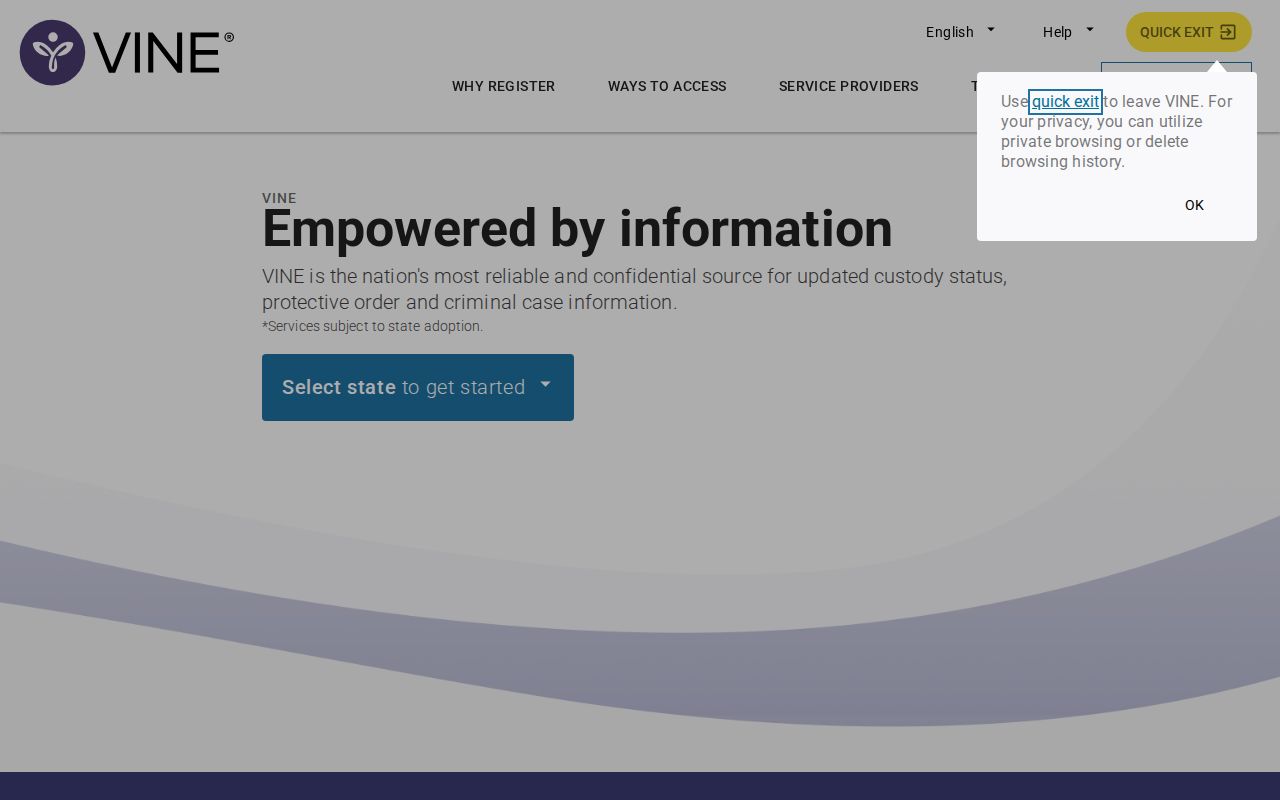
The captured screen shows why selecting Michigan before the name search is essential for avoiding a wrong-state match.
Note: Keep registration contact details private and confirm the selected record before enabling any alert method.
Michigan’s Two Release-Notice Layers
Michigan separates automated custody alerts from expanded MDOC victim notice. MI-VINE reports county release, transfer, and escape events and supplies general MDOC release notification. A direct crime victim seeking broader notice about parole hearings and decisions must separately enroll with the MDOC Crime Victim Notification Unit at 877-886-5401.
The two enrollments are not duplicates. MI-VINE follows the supported custody event. The MDOC victim-notification process covers case-specific parole information beyond the general VINE release notice. A person who needs both types must use both official channels.
Public parole-hearing information has another boundary. Michigan does not post every routine parole interview on a named-person calendar. Public lifer, pardon, and commutation notices use the Parole Board registration and press-release channels. That public process does not replace victim enrollment, and an aggregate quarterly decisions report does not provide a person-level result. OTIS is still the practical public status check after action.
The official MI-VINE brochure explains the event types and the separate MDOC notice route. Its warning against sole reliance is important. Personal safety plans should never depend on one automated call or data feed.
Iron County Victim Notice Help
Iron County’s Prosecuting Attorney publishes a local Victim Rights Coordinator. That office can address case process and local victim-rights questions, while MI-VINE remains the automated custody-change service. The courthouse office and the state alert system serve different purposes.
Iron County Victim Rights Coordinator
2 South Sixth Street, Suite 1
Crystal Falls, MI 49920
906-875-6628
Weekdays, 8:00 a.m. to noon and 12:30 p.m. to 4:00 p.m., except holidays
MI-VINE Assistance
Custody information and registration help
800-770-7657
TTY: 866-847-1298
Available 24 hours a day
A call to the local coordinator does not replace a jail release record. It can help explain case progress and local procedures. The Iron County jail, court, MI-VINE, and MDOC each remain responsible for their own records or notice stream.
Iron County VINELink Release Limits
VINE is not a guaranteed permanent history. A data feed may lag, a person may be listed under a different spelling, or an old event may no longer be available. The system itself warns against sole reliance. For the exact county release time and reason, use the record route on the official Iron County jail page and the court order that authorized the event.
VINELink does not replace the BOP Inmate Locator for federal sentence custody. A federal pretrial person may be moved by the U.S. Marshals Service before BOP has a useful record. ICE custody also has its own locator. A county departure to either authority is a transfer, not proof of community release.
A released county-jail person will not appear in OTIS merely because Iron County held them. OTIS applies when MDOC had prison, parole, or qualifying probation authority. Conversely, a state prisoner’s VINELink general release alert should be checked against OTIS status and Date Paroled. Final discharge is a separate field and event.
Iron County also has a published federal jail-services agreement. A federal detainee can leave the county facility in U.S. Marshals Service custody, and BOP may not yet show a useful record for a pretrial movement. In that situation, use the federal docket and responsible federal agency, then the BOP locator after designation. If facts point to immigration custody, use the ICE locator. VINELink should not be stretched across those federal systems.
| Question | Best source |
|---|---|
| Did Iron County custody physically end? | Iron County jail release sheet or direct jail confirmation |
| What court action authorized release? | 95B District Court or 41st Circuit Court record in MiCOURT |
| Did MDOC prison custody end in parole? | OTIS status and Date Paroled |
| Did federal sentence custody end? | BOP locator and federal court record |
| Was the county event a transfer? | Releasing agency plus the receiving custodian |
Use MI-VINE for timely notice, then verify the result with the source that can answer the exact question. This prevents a transfer alert from being mistaken for freedom and keeps county, state, and federal records in their proper lanes.
Note: Record the reporting facility and check time because a status without its source and date can be easy to misread.