
Iron County Parole Versus Probation
Michigan places both parole and probation work within the Michigan Department of Corrections Field Operations Administration. The labels still mean different things. Parole begins after a person leaves an MDOC prison placement and continues while the person remains within the sentence. Probation is a court-ordered form of community supervision. It may follow a jail term, but it can also be imposed without any state-prison confinement.
An OTIS status of “Parolee” supports that the person left prison and is supervised by MDOC. “Probationer” confirms probation supervision, not a past prison release. A “Discharged” result within the public display window means MDOC supervision has ended. The Iron County court file can show the order that imposed probation, while OTIS is the best public path for the current MDOC status and assigned office.
| Point | Parole | Probation |
|---|---|---|
| What starts it | Release from an MDOC prison under a Parole Board decision | A sentence or order entered by the court |
| What it proves | The person left prison but remains under MDOC authority | The person is supervised in the community, with no required prior prison stay |
| Best public check | OTIS status, Date Paroled, and supervision location | OTIS status plus the sentencing court record |
| End point | Final MDOC discharge or another lawful termination | Probation discharge shown by the court or MDOC record |
- Parole
- Supervised release from prison before the maximum sentence endpoint.
- Probation
- Community supervision ordered by a court, sometimes without a prison term.
- Discharge
- The recorded end of the MDOC sentence or supervision term.
- Absconder
- A person reported as not complying with required supervision contact, not proof of current confinement.
Check Iron County Post-Release Supervision
The official MDOC OTIS overview explains that the public system includes prisoners, parolees, probationers, and people discharged within the prior three years. It does not include people whose only custody was an Iron County jail sentence. Search with a full name or MDOC number, then use status filters and personal identifiers to avoid a same-name match.
A disciplined check reads the whole profile. The supervision location can be more useful than the sentencing county because people may live and report outside Iron County. Likewise, someone supervised in Crystal Falls might have been sentenced elsewhere. The OTIS search application should establish the public status before anyone calls a field office.
- Search by MDOC number when it is known. Otherwise enter the last and first name and narrow the result by age, status, or other available fields.
- Open the matching profile. Compare aliases, physical details, offenses, sentencing county, and MDOC number rather than relying on a photo alone.
- Read “Parolee,” “Probationer,” “Discharged,” or an absconder status in context. A prison location means the person remains in state custody.
- Check the supervision location. Contact that assigned office, even if the conviction arose in Iron County.
- For a disputed court-derived item, contact the sentencing court. For an office assignment or supervision status issue, contact the listed MDOC office.
The full county release and records path is covered on the Iron County released inmates search. That path is useful when OTIS has no result because the person may have had jail-only custody.
Note: OTIS generally removes a discharged profile after three years, so a blank older search does not prove that supervision never existed.
Iron County Parole Office Details
Iron County has a combined MDOC Parole/Probation office within Outstate Region 1. It shares the 2 South Sixth Street courthouse complex with the jail and court, but each suite belongs to a different custodian. The close location does not merge their records. Jail release facts remain with the Sheriff, court orders remain with the clerk, and supervision facts remain with MDOC.
Iron County Parole/Probation
Michigan Department of Corrections
2 South Sixth Street, Suite 24
Crystal Falls, MI 49920
906-875-4011
Michigan Parole Board
Parole-Board-Staff@michigan.gov
517-373-0270
Monday through Friday, 8:00 a.m. to 5:00 p.m.
The field office can address the assigned supervision record. It is not the right office for a jail release sheet. When an OTIS fact came from a judgment, MDOC directs correction requests to the sentencing court. When the disputed item concerns supervision or absconder status, the assigned office is the proper starting point.
The building address can create a false sense that one call reaches every record. The Iron County Correctional Facility is in Suite 18, the District Court Clerk is in Suite 5, and MDOC supervision is in Suite 24. Ask for the agency and record type by name. A jail clerk can confirm county custody, a court clerk can locate the order, and the field office can verify the supervision location shown in OTIS. The Iron County Trial Court directory identifies the separate court contacts.
Iron County Parole Decision Records
The Michigan Parole Board is the sole paroling authority for felony offenders committed to MDOC. Time eligibility does not promise release. Under MCL 791.233 and 791.234, the Board still makes the statutory release judgment after it gains jurisdiction. The ordinary process begins before eligibility or reconsideration, includes an interview, and can end in a grant or denial.
A grant moves to the Parole Release Unit. That unit records the proposed parole date, parole term, special conditions, and placement work. MDOC states that at least 28 days normally separate the decision from physical release. New information or misconduct can suspend or delay a grant. The best public proof of actual departure is the later “Date Paroled” and parole status in OTIS, not the favorable decision by itself.
The public hearing registration page is not a calendar of every routine parole interview. It covers public lifer, commutation, and pardon matters. Notices usually appear about two weeks to 30 days before those hearings, and the page prohibits recording or screenshots of proceedings. Quarterly Parole Board decision reports are aggregate reports, not a named-person results database.
The official Michigan Parole Board page shows the agency role and eligibility framework. Its public view helps distinguish a pending decision from an actual parole date.
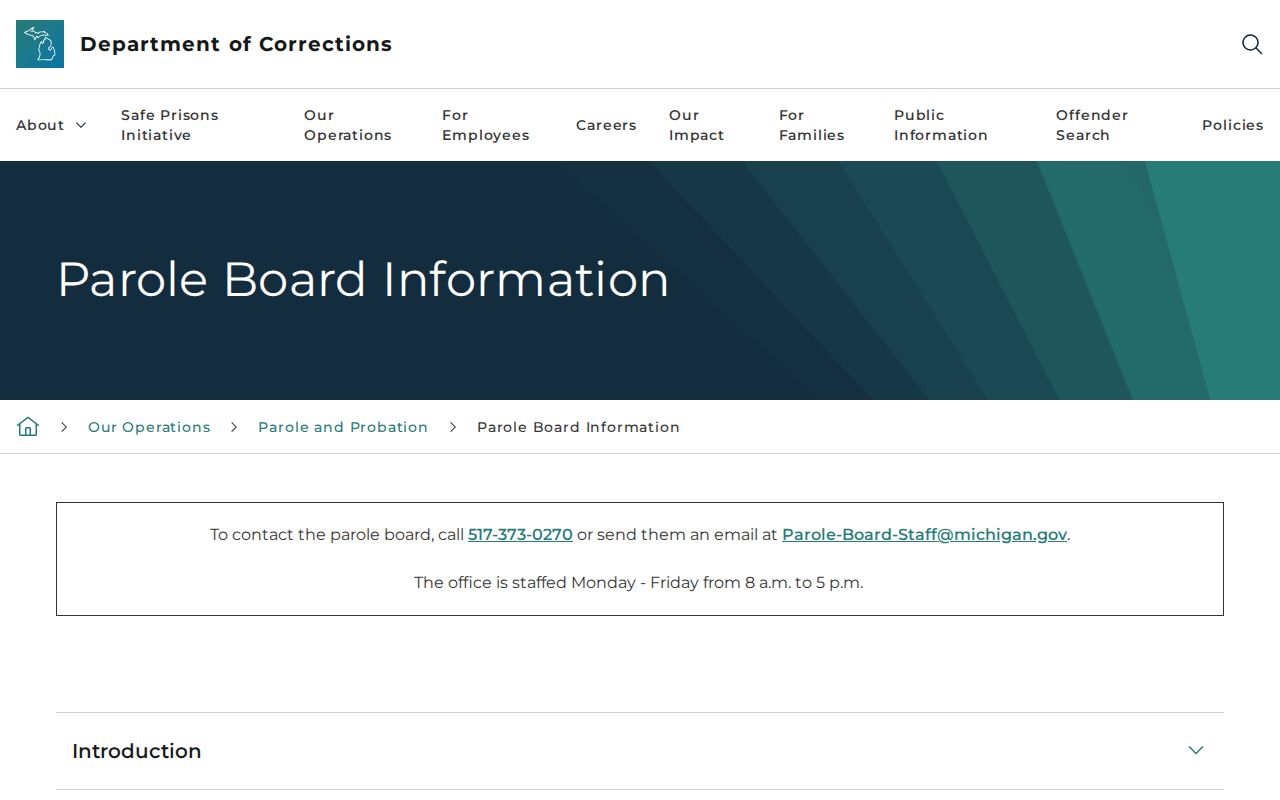
The captured state page identifies the Board as the release authority, while OTIS remains the practical status check after action occurs.
Note: A grant and a prison exit are separate events, so confirm the Date Paroled before treating the person as released.
Iron County Supervision Violations
Parole and probation conditions are case-specific. They can govern reporting, travel, approved placement, and other conduct set by the order or supervising authority. A public summary cannot establish every term. The order, parole documents, and assigned agent are the sources for the actual conditions.
OTIS includes “Parole Absconders” and “Probation Absconders” among its status options. That label signals a supervision problem. It does not establish that the person is now in the Iron County Correctional Facility or another prison. A warrant, arrest, hearing, or revocation requires separate proof from the office, court, or custody agency. MDOC also publishes aggregate absconder reports, but those reports are not the primary named-person lookup.
When a status raises concern, note the profile date and assigned office before calling. Do not infer a new offense or custody location from “absconder.” If a person is arrested on a supervision matter, the live custodian must confirm the booking. OTIS and the field office then explain the supervision side.
Iron County Work-Van Context
Regional reporting described plans to restart Iron County’s work-van program in January 2025 after a pandemic-era shutdown. The report said a part-time deputy was involved and policies were still being finalized. That makes the program a useful piece of local corrections context, but not proof that a named person had community release status or received post-release transport.
The local work-van report also underscores why program participation and legal release must not be merged. A person can take part in structured work activity while remaining subject to custody or supervision rules.
The source documents a local program plan, not an individual release record, discharge, or promise of transportation.
Iron County Supervision Discharge
Supervision ends through an official discharge or other lawful termination, not merely because a person stops appearing at a familiar office. A recent OTIS profile may show “Discharged” with a discharge date and reason. For probation, the Iron County court file may also contain an order of discharge. Those documents answer different parts of the question, so compare them when exact timing matters.
Michigan’s three-year OTIS display rule limits the public window after discharge. Older proof may require the sentencing-court file or a focused MDOC records request. A set-aside can also change public visibility. Neither a timed removal nor a lawful set-aside means that a past custody or supervision event can be reconstructed from a blank current search.
For a specific parole record, request only the document that answers the question, such as an Order of Parole, discharge certificate, or public status record. MDOC’s general FOIA route is the proper fallback when the public profile is gone or lacks the needed field. The agency’s FAQ describes a PENPACK, but that certified criminal-justice packet is restricted to recognized authorities. A general requester should not expect it. A narrow request for an identified nonexempt record is the sounder path.
Keep the final terms clear: parole records prison exit into state supervision, probation records court-ordered community supervision, and discharge marks the end of the relevant state term. That distinction prevents a release date from being mistaken for the end of every obligation.
Note: Match names with an MDOC number, birth details, or case number because a same-name record can lead to the wrong office.