
Iron County Scheduled Versus Actual Release
A projected date is a forecast or sentence milestone. It does not prove physical departure. A hold, warrant, new sentence, court amendment, disciplinary event, transport issue, or Parole Board action can change what happens. The actual release record comes after staff complete the event and record the time, authority, and destination.
Michigan’s public state-prison terms are more precise than “projected release date.” The Michigan Department of Corrections uses Earliest Release Date for the point when the minimum term and applicable credit rules may allow Parole Board jurisdiction. Maximum Discharge is the outer sentence endpoint if parole does not occur, subject to lawful recalculation. Neither is a promised exit appointment.
A pretrial Iron County detainee often has no sentence-based date at all. The live issues are bond, case orders, and holds. Even a signed release order can precede jail processing. For historical proof, reconcile the order with the Iron County Correctional Facility’s actual release timestamp.
Find an Iron County Projected Date
The correct search depends on custody class. OTIS covers MDOC prisoners, parolees, qualifying probationers, and people discharged within its public window. It excludes jail-only cases. Iron County has no MDOC prison, but a person sentenced in the 41st Circuit Court may be housed at any state facility and still be linked to Iron County in the offense information.
For a county case, begin with the MiCOURT Case Search. The Iron County Trial Court directory identifies the local 95B District Court and 41st Circuit Court contacts. The district record may show bond, misdemeanor, and preliminary felony events. The circuit record carries felony judgments and MDOC commitments. A court event explains the legal basis, while the jail or MDOC supplies the custody date.
- Identify whether the person is awaiting trial, serving an Iron County jail sentence, or serving an MDOC sentence.
- For state prison, open OTIS and search by MDOC number or full name. Match age, aliases, physical details, convictions, and sentencing county.
- Read Earliest Release Date, Maximum Discharge, status, location, Date Paroled, and discharge fields together. Do not rename an eligibility field as a guaranteed release.
- For an Iron County jail term, obtain the judgment and jail-credit facts from the court, then ask the jail how its records reflect the calculation.
- For pretrial custody, check bond and release orders, then call the jail to confirm that processing finished and ask whether departure was release or transfer.
- When the event matters as proof, request the maintained release sheet or state record rather than relying on an expected date.
The Iron County released inmate search path explains the full county, state, court, and transfer ladder for a named person.
Note: A future date beside an active prison location means the person remains in MDOC custody until a later verified event.
Iron County OTIS Date Fields
The official OTIS overview defines who appears in the state system. Search results can expose much more than one date, and every field must be tied to status. A “Parolee” record with Date Paroled supports an actual prison departure into supervision. A “Discharged” record with a date and reason supports the end of MDOC authority within the public window.
| OTIS field | What it means for release |
|---|---|
| Earliest Release Date | First possible Parole Board jurisdiction under the sentence and applicable credit rules, not an exit promise |
| Maximum Discharge | Outer sentence endpoint if parole does not occur, subject to lawful changes |
| Date Paroled | Recorded departure from prison into parole supervision |
| Discharge Date and Reason | End of the MDOC sentence or supervision record |
| Status and location | Whether the person remains in prison, is on supervision, or is discharged |
| Sentencing county | Connects the state record to an Iron County judgment when applicable |
OTIS ordinarily keeps discharged profiles public for three years. An older blank result is therefore not proof that MDOC never held or supervised the person. A focused MDOC records request or sentencing-court file may be needed for an older discharge date.
Iron County Truth-in-Sentencing Dates
Michigan is not a generic “serve 85%” state. The MDOC truth-in-sentencing explanation states that covered prisoners must serve 100% of the court-imposed minimum in prison before parole consideration. Specified assaultive offenses committed on or after December 15, 1998, and other covered crimes committed on or after December 15, 2000, fall within the published framework.
For those covered cases, truth in sentencing removed good time, disciplinary credits, and corrections-center placement before completion of the minimum. A Class I misconduct adds disciplinary time that the Parole Board may consider. No sound calculation starts by subtracting a standard percentage from a modern Michigan minimum.
The statute still requires careful reading. MCL 791.234 governs Board jurisdiction and includes special rules and exclusions. Some life sentences are nonparolable, while parole-eligible life terms use distinct calendar-year rules based on the offense and date. Eligibility never commands a grant.
The Michigan corrections FAQ describes Earliest Release Date and Maximum Discharge as sentence information, not a promise of actual release. That source view is the right place to check how MDOC explains a public date.
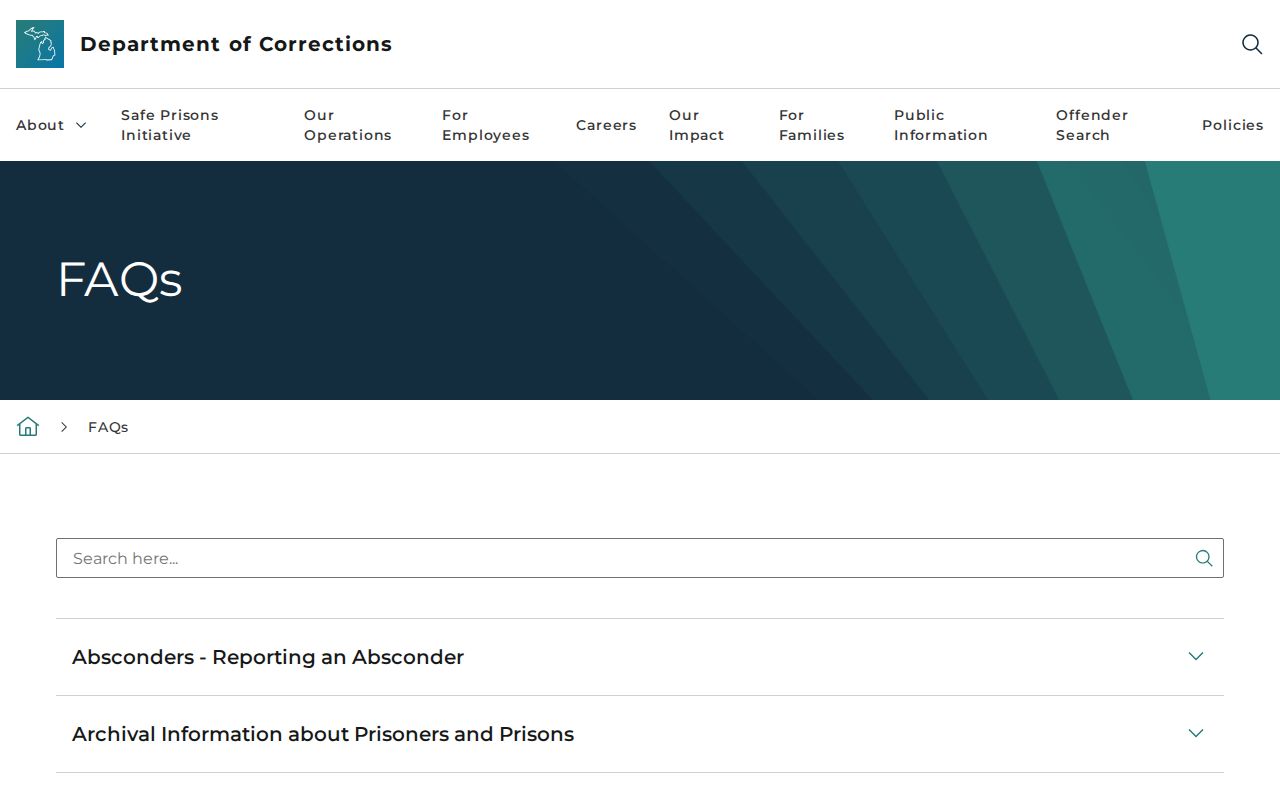
The captured FAQ reinforces the central distinction between eligibility, maximum discharge, parole action, and physical departure.
Iron County Jail Good-Time Rules
Legacy state cases and county-jail sentences need separate treatment. For eligible older state offenses, MCL 800.34 and the related sentence laws distinguish disciplinary time from older credit systems. MCL 800.33 may govern legacy credits. The research supports a general older-case description of five days per month plus possible special credits in eligible circumstances, but forfeiture and statutory limits can apply. Offense date controls.
A local jail sentence does not use the state-prison OTIS computation. MCL 51.281 through 51.283 supplies Michigan’s county-jail good-behavior allowance framework and recordkeeping authority. The actual Iron County date must come from the judgment, jail credit, conduct record, and the jail’s calculation.
No public Iron County policy was found that sets a unique weekend-release practice or fixed release hour. Do not move a calculated date to a Friday, promise a same-day exit, or infer processing time. The official county jail page gives the local custody contact. Call 906-875-0651 and ask how the maintained record applies to the specific sentence.
- Jail credit
- Time the judgment credits toward the sentence.
- Concurrent
- Sentences that run at the same time as ordered.
- Consecutive
- Sentences that run one after another as lawfully imposed.
- Detainer
- A request or hold from another authority that can affect the destination after local custody ends.
Note: The county good-time statute supports a framework, but only the court and jail records support a date for a named person.
Why Iron County Release Dates Change
A credible date check uses the judgment, offense date, jail or prison credit, sentence structure, disciplinary record, amended orders, and the current MDOC computation. A single public date cannot reveal all those inputs. The table identifies the fact that must be checked when an expected date moves.
Start with the judgment because it sets the legal terms. Then identify every count and whether the terms run at the same time or one after another. Check jail credit, the offense date, and any later amended judgment. For an MDOC term, compare those court facts with the current OTIS dates. If they do not align, ask the sentencing court about court-derived data and ask MDOC about the computation. Avoid doing date arithmetic from a docket caption alone.
| Changing factor | Effect on the expected release | Best source |
|---|---|---|
| Amended sentence or resentencing | Changes the legal term or credited time | Iron County court judgment and register of actions |
| Consecutive sentence or new case | Adds time or prevents departure under the first case | Court records and MDOC computation |
| Misconduct or disciplinary time | Affects credit or Board review under the applicable law | MDOC record or lawful jail record |
| Parole grant, denial, or delay | Moves the actual exit within the sentence framework | Parole Board record and OTIS status |
| Detainer or transfer | Ends one custody while sending the person to another authority | Releasing and receiving agencies |
| Appeal or new court order | Changes the authority for continued custody or release | MiCOURT and signed orders |
A transfer can create a county release timestamp without community freedom. Iron County also has a published U.S. Marshals Service jail agreement, so federal movement is a real conditional path. The county jail can confirm its own handoff, but the receiving agency must confirm the next status.
Parole timing adds another gap between eligibility and exit. MDOC begins the consideration process before the eligibility or reconsideration point, and a favorable decision proceeds to release planning. The Parole Release Unit handles the proposed date, term, conditions, and placement. MDOC says at least 28 days normally stand between the decision and physical release. Later information or misconduct can still affect the grant. Only the updated OTIS status and Date Paroled support the actual prison departure.
Confirm an Iron County Release Date
Use the date field that matches the question. For prison eligibility, read Earliest Release Date. For actual prison departure to supervision, read Date Paroled and status. For the end of MDOC authority, use Discharge Date and Reason. For Iron County jail departure, ask for the release sheet with time, authority, type, and destination.
MI-VINE can send a custody-change alert, but it is not a certified historical record and may reflect a transfer from the reporting agency. Registration details are covered on the Iron County VINELink Check. For a court-based date, confirm the signed order and then confirm that the custodian carried it out.
If sources conflict, record when each one was checked and contact the agency that physically held the person. That agency can confirm whether custody ended, while the court explains the authority and the receiving system establishes any next hold.
For an older state case, public OTIS visibility may end three years after discharge. That is an online display limit, not a universal record-destruction rule. The sentencing-court judgment can preserve the legal sentence, and a focused MDOC request can seek a discharge or time-computation record. For a past Iron County jail sentence, request the booking and release material from the Sheriff rather than expecting OTIS to hold a jail-only record.
Note: “Parole granted” normally precedes physical release, so it should never be presented as the same event as Date Paroled.