
Iron County USMS Custody Path
The published intergovernmental agreement is evidence that the U.S. Marshals Service arranged jail services with Iron County. It does not establish that a federal detainee is held there now. It also does not convert Iron County Correctional Facility into a BOP prison. The Sheriff operates the local jail; USMS may use local contract custody for a person tied to federal court proceedings.
A federal detainee often remains under USMS responsibility during pretrial proceedings and after a court remand. “Remand” means a court directs that the person be held. The Marshals Service may move the person between facilities. BOP generally takes the later sentenced-custody role after commitment and designation. A release inquiry must identify which stage existed on the date in question.
| Event | What it means | Verification |
|---|---|---|
| Iron County release to USMS | County physical custody ended; federal custody continued | Jail release/transfer record and federal docket |
| Federal court release order | Legal authority changed | Signed docket entry plus physical-custody confirmation |
| Commitment to BOP | Federal sentence custody moved into BOP’s system | Judgment, docket, and BOP Inmate Locator |
| BOP Released result | BOP custody ended | BOP release date plus federal judgment and any receiving custodian |
No Public USMS Name Locator
No nationwide public USMS name locator equivalent to the BOP Inmate Locator was identified in the Iron County research. That is a key limitation. A missing BOP result during the federal pretrial stage does not prove release because the person may still be in USMS custody and housed in a local contract bed.
Use the case and agency path instead:
- Call Iron County Jail at 906-875-0651 to ask whether the person is presently held and, if not, whether the county record identifies a federal transfer.
- Search PACER for the federal case. Review detention, remand, bond, judgment, and release-related entries.
- Confirm the responsible federal district and use official USMS prisoner information for agency context.
- After sentence commitment or designation, search the BOP Inmate Locator by register number or name.
- If a transfer record identifies ICE, use ICE ODLS rather than treating the USMS exit as community release.
Iron County Federal Handoff Rules
The agreement gives Iron County’s federal-transfer issue unusually specific local detail. It permits release of a federal detainee only to the federal agency that committed the person, a Deputy U.S. Marshal, or an agent named by a deputy. This supports a controlled handoff, not an inference that the person walked out free.
The agreement also calls for seven days of prescription medication at release or transfer and for medical records to accompany the person. These terms apply to covered federal detainees. They should not be generalized to all people leaving the Iron County jail. Their value for a record inquiry is narrower: they confirm that “release” in the agreement can mean delivery to an authorized federal recipient.
- Contract custody
- Local jail space provided under an agreement for another government.
- Handoff
- A controlled transfer from one custodian to the next.
- Designation
- The federal process that assigns a committed person to a BOP placement.
- Federal docket
- The court’s chronological case record of orders, filings, and judgments.
The federal agreement should be read together with the county’s actual release entry. An agreement proves the legal framework. It does not prove a named person was transferred on a given day.
Request Iron County USMS Records
Iron County Sheriff Ryan Boehmke’s office is the custodian for the jail’s physical booking and movement record. Ask for the booking/release sheet or custody-status history for the person and date range. Request the actual date and time Iron County custody ended, the maintained release authority or type, and the transfer destination. A federal case number, booking number, full legal name, and date of birth can reduce same-name error.
Send a focused written request to Iron County FOIA Coordinator Mary Dalpra, 2 South Sixth Street, Suite 7, Crystal Falls, MI 49920, telephone 906-875-3301, or mdalpra@ironmi.org. The county posts its FOIA form and procedures. Michigan law does not require use of the county’s preferred form, but the form provides useful routing details.
Ask for existing records, not a new explanation. The county does not have to create a custom federal custody summary. If a disposition code is hard to read, request the native code and any existing legend. If part of the record is withheld, seek reasonably separable nonexempt portions and the stated legal basis.
The published county procedures allow in-person, mail, fax, or email delivery. Email and fax requests are treated as received on the following business day. Standard letter or legal copies may cost up to ten cents per sheet, while qualifying labor, media, and postage may also be charged. Request an itemized estimate and electronic delivery when possible.
Read Iron County Federal Dockets
The federal court record explains why custody continued or ended. A detention order can show why USMS held the person. A bond or release order changes legal authority. A judgment can commit the person to BOP. Later docket entries may address sentence changes or supervised release. The Western District of Michigan is the local federal court source identified in the research, but use the district named in the actual case.
A signed court release order may precede physical processing. Therefore it is strong legal evidence but not the jail exit timestamp. The county transfer line supplies that time. If BOP later lists a past Release Date and “Released” or “Not in BOP custody,” that supports the end of BOP custody, not necessarily the end of all federal supervision or another agency’s hold.
Where did the detainee go after Iron County? The county destination field is the starting point. The federal docket establishes the legal stage. BOP answers a later prison-custody question. No one system should be made to answer all three.
Iron County BOP Follow-Up
Once the person enters BOP records, search by register number when possible. BOP also accepts DCDC, FBI, and INS identifiers, or a name plus descriptors. Compare the register number, age, race, sex, release date, and location or status with the judgment. Keep the date checked because federal records can change as sentence calculations are updated.
The manifest’s successful image comes from the official BOP Inmate Locator.
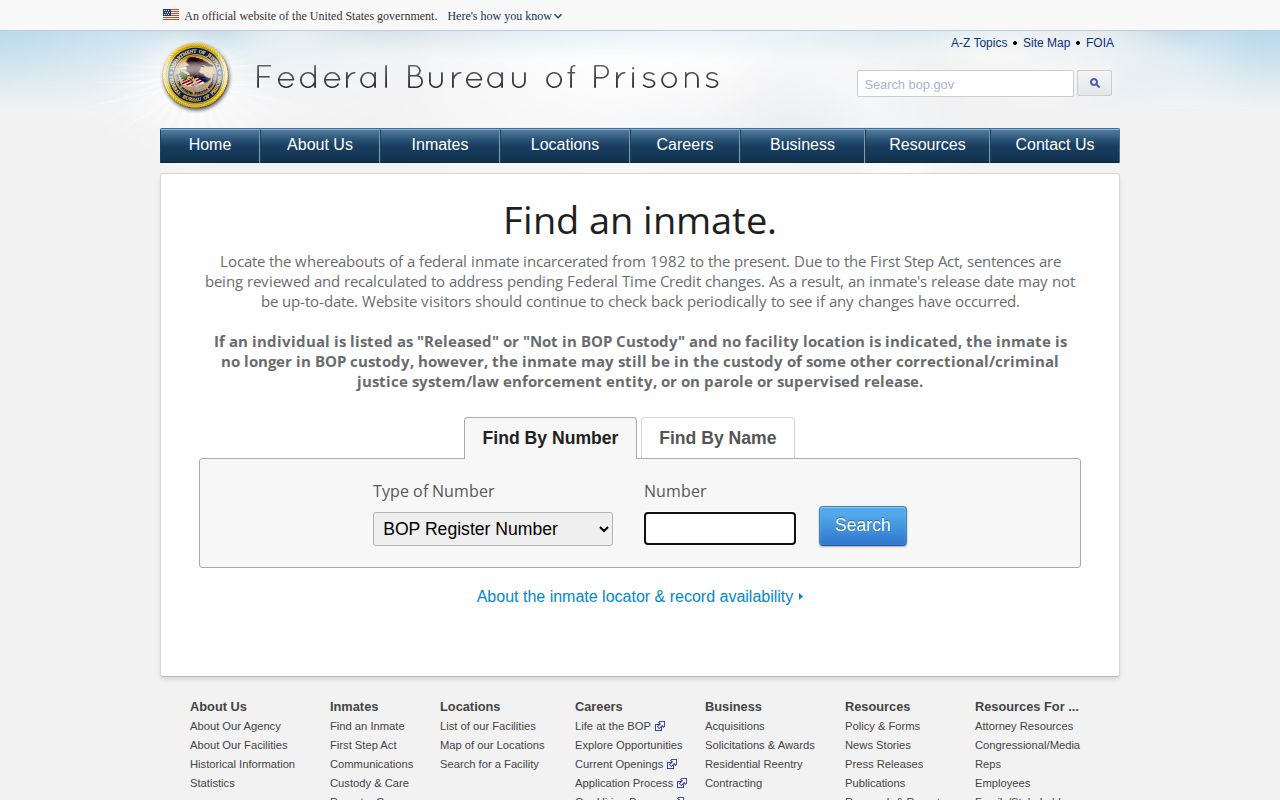
The public form is useful after BOP entry, but it does not replace the federal docket during the earlier USMS stage.
BOP records generally cover federal inmates from 1982 onward. A released result may show a past date when no facility remains. A future date is not proof of exit, and First Step Act recalculation can affect displayed projections. Verify a completed event through the past date and court record.
Separate Iron County Federal Custody
County, USMS, BOP, MDOC, and ICE custody are distinct. The Iron County jail records the local physical stay. USMS manages many federal court detainees. BOP tracks federal sentence custody. MDOC tracks Michigan state sentences. ICE tracks covered immigration detention. A person can move between these classes without community release.
The verification ladder is simple: actual holding-agency record, receiving-agency record, court authority, then any supervision record. When sources conflict, ask the agency that made the physical transfer and note when each database was checked. The Iron County released-inmates search provides the broader county-to-federal classification.
Do not use a current-custody absence as a historical conclusion. “Not here now” does not answer when custody ended, why it ended, or who received the person. A focused release/transfer record does.
Iron County’s courthouse geography can make the split easy to miss. The Sheriff’s jail, trial-court offices, and local MDOC parole/probation office all use suites at 2 South Sixth Street. Federal authority remains separate even when a USMS detainee is housed in that complex. Name the office and record custodian, not just the street address, when making an inquiry.
Iron County Trial Court records also use Central Time business hours, while the jail operation is staffed around the clock. A late-day federal transfer may not be reflected in a court inquiry until the relevant office is open. One failed phone connection is not proof of release or refusal. The court page notes intermittent connection issues and directs callers who cannot connect to email the relevant department with a callback number.
Note: The USMS agreement proves an available contract path, not that any named federal detainee is currently held in Iron County.